Home › For HR teams
For HR teams
HR conversations, transcribed — and kept in-house
Investigations, grievance hearings, disciplinaries, exit interviews: conversations where an accurate record matters most and where the audio absolutely should not sit on a transcription vendor's servers. Lesskeys processes everything on the Mac in the room.
Employee audio is exactly what shouldn't leave the building
The recordings HR handles — allegations, health disclosures, departures — are the most sensitive employee data an organisation holds. Sending them to a cloud transcription service adds a processor to your data map, with everything that entails in many jurisdictions: agreements, assessments, another breach surface. On-device transcription keeps the processing on a company Mac under controls you already have. Lesskeys makes no compliance claim — it removes a party; confirm specifics with your counsel or data-protection officer.
An accurate who-said-what record
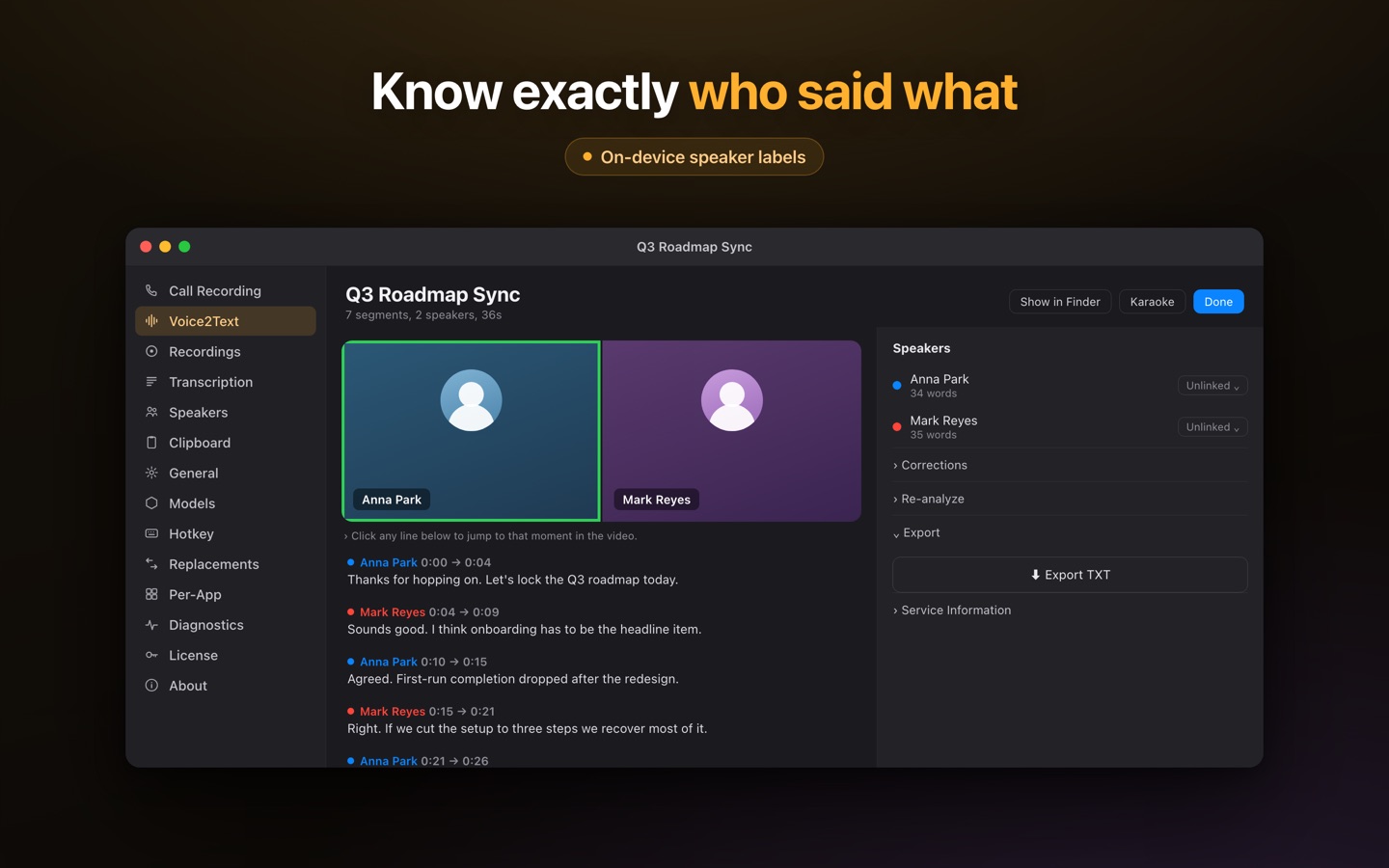
In a hearing, attribution is the record. Lesskeys transcribes with automatic speaker labels, so the transcript shows who asked, who answered, and what exactly was said — reviewable against the audio at any point. That's a stronger artifact than contested handwritten minutes, and it frees the note-taker to actually run the meeting.
Consent first, always
Recording workplace conversations is regulated and varies by jurisdiction — and covert recording poisons trust and often the record's usability too. Tell participants, get consent per your policy and local law, and note it at the top of the meeting. On-device processing then answers the follow-up question employees reasonably ask: where does this recording go? Nowhere. It stays on the company machine.
Exit interviews and the patterns in them
Exit interviews are candid exactly when people trust the handling. A local recording with a searchable transcript lets you honour that trust and still find the pattern across a quarter's departures — the recurring manager, the recurring reason — without shipping a single conversation to a vendor.
A working setup for a case
- Open with consent — state that the meeting is recorded on a company device and processed locally; record the agreement.
- Capture and transcribe — the hearing becomes speaker-labeled text on the Mac, minutes after it ends.
- Verify contested points — the transcript sits next to the audio; check any disputed line against the recording.
- Store under your controls — files live where your retention policy says, on infrastructure you already govern.
Pay once. No subscription. · macOS 13+
FAQ
Can we record HR meetings?
Only per your policy and local law — consent rules vary by jurisdiction, and participants should always be told. Lesskeys answers the data-handling half: the recording and transcript stay on the company Mac, with no third-party processor involved.
Does using it keep us GDPR-compliant?
No tool makes an organisation compliant by itself. What on-device processing changes is the data map: employee audio is never sent to a transcription vendor, so there's one less processor to contract with and account for. Confirm specifics with your counsel or DPO.
Can it tell speakers apart in a hearing?
Yes — automatic speaker labels separate participants, so the record shows who said what. You can review any line against the audio.
Does it need internet or an account?
No. After the one-time model download it runs fully offline, with no account and no login — nothing about a case ever touches a network service.