Home › What is on-device transcription?
What is on-device transcription?
On-device transcription means your speech is converted to text locally on your own computer — using speech models that run on your hardware — with nothing uploaded to the cloud. It's also called local or offline transcription.
·
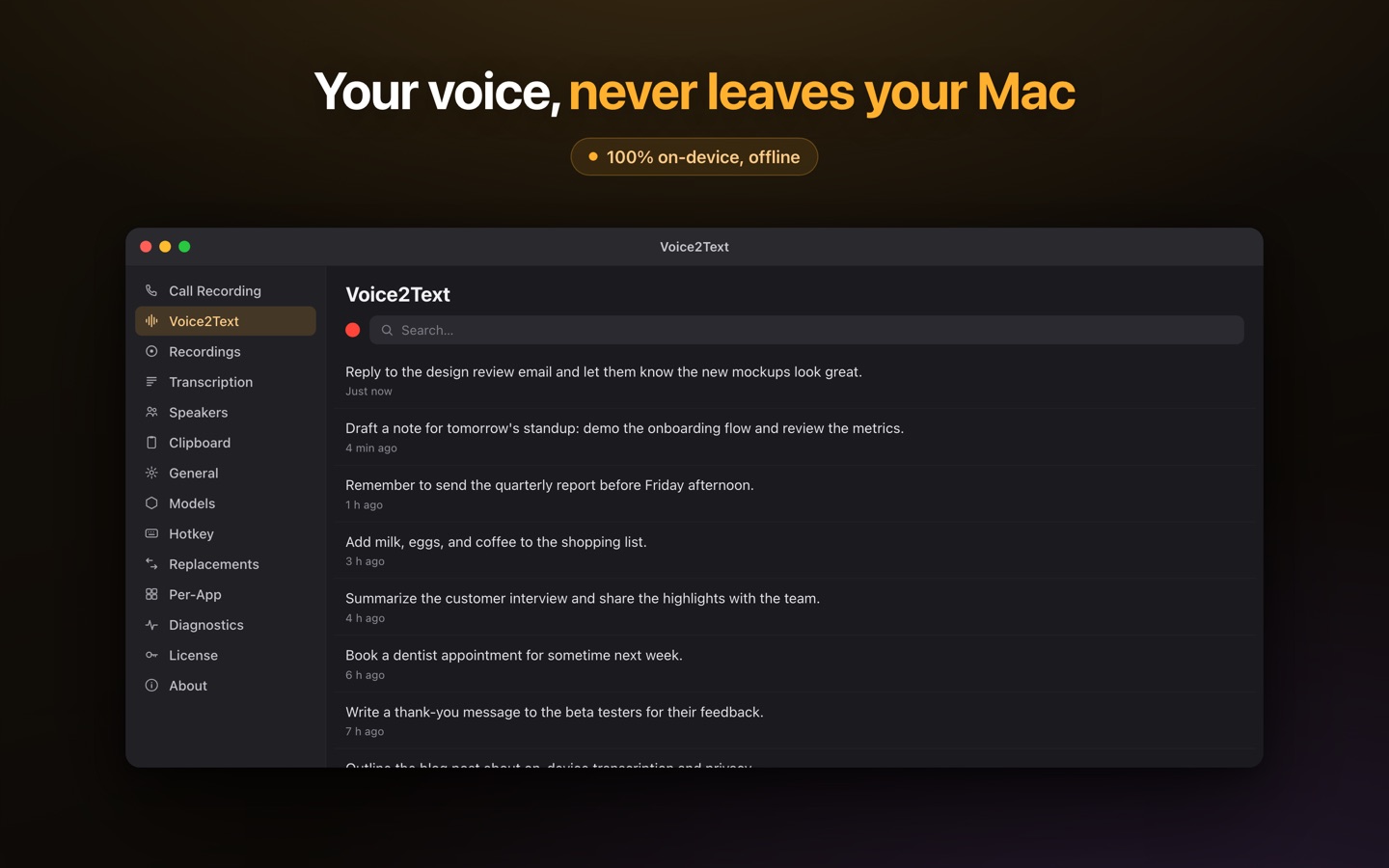
On-device vs cloud transcription
The difference is where the processing happens. Cloud transcription tools record your audio and send it to a remote server, which does the speech recognition and often keeps a copy. On-device transcription runs the recognition on your own machine, so the audio never leaves it. Practically, that means on-device tools work offline, need no account, and don't expose your recordings to a third party.
| On-device | Cloud | |
|---|---|---|
| Where audio is processed | Your computer | Remote server |
| Works offline | Yes | No |
| Audio leaves your device | No | Yes |
| Account required | No | Usually |
| Ongoing cost | Often one-time | Usually per-minute / subscription |
On-device, local, offline — and speech recognition vs speech-to-text
These terms name the same thing from different angles, which is why search results for them overlap. On-device (or edge) describes where the model runs; local says the same in desktop software; offline describes the consequence — no network is needed. Speech recognition, speech-to-text and automatic speech recognition (ASR) all name the underlying task of turning audio into words. Transcription usually means applying that task to a whole recording and producing a readable document, often with timestamps and speaker labels. So “on-device speech-to-text” and “local transcription” describe one product category, not two.
What it takes to run on your own machine
A speech model is a file you download once and then run on your own hardware. On Apple Silicon it is loaded into unified memory and executed on the GPU through Metal, so the practical requirement is a recent Mac rather than a fast connection. The trade-off is download size against accuracy, and it is measurable rather than a matter of taste. On a 6,086-word reference recording we measured Large V3 at a 2.35% word error rate from a 3.1 GB download, and Large V3 Turbo Q5 at 2.53% from 574 MB — a difference of 13 errors in 6,086 words for a file five times smaller. Small (488 MB) reached 3.55%, and Tiny (78 MB) 6.87%. The full method and every number is in the Whisper model benchmark.
In other words, a laptop can now run the accurate models, not just the fast ones. That is the change that made on-device transcription practical — the models got small enough before the hardware got fast enough.
When cloud transcription is still the better choice
On-device is not the right answer to every job, and it is worth being direct about where it loses:
- Hardware you don't have. Local models need a capable GPU and several gigabytes of memory. On an old machine, a thin client or a phone-only workflow, a server does the work better.
- Shared, org-wide archives. If a whole team must search everyone's calls from a browser, that is a hosted database by definition — not something a local app provides.
- A bot that attends for you. Cloud notetakers can join a meeting you are not in. A local tool records the audio your own machine can hear, so someone has to be there.
- Live captioning at scale. Streaming captions for a large event lean on infrastructure a laptop is not asked to provide.
The honest boundary is this: if the recording is sensitive, or you want it to keep working without a connection or a subscription, on-device wins. If the job is fundamentally about many people sharing one archive, it does not.
Why it matters
If your recordings are sensitive — interviews, client calls, medical or legal discussions, internal meetings — uploading them to a cloud service means a copy exists somewhere you don't control. On-device transcription removes that exposure by design: the audio and the transcript stay on your machine. It also keeps working on a plane, in a secure facility, or anywhere without reliable internet.
Is it accurate?
Yes. Speech-recognition models that run on Apple Silicon's GPU are highly capable, and for the vast majority of dictation and transcription tasks they're comparable to cloud services — without the privacy trade-off. Some tools even offer multiple local engines so you can pick the best one for a given language or recording.
How to do on-device transcription on a Mac
Lesskeys is a Mac app built entirely around on-device processing: system-wide dictation, plus call, interview, and video transcription with automatic speaker labels — all local, offline, and a one-time purchase. If you want to understand the mechanics, see how local transcription works.
Pay once. No subscription. · macOS 13+
FAQ
What is on-device transcription?
Speech converted to text locally on your own computer, using models that run on your hardware, with nothing uploaded to a server. Also called local or offline transcription.
How is on-device transcription different from cloud transcription?
Cloud transcription sends your audio to a remote server to process and store. On-device does the processing on your own machine, so audio never leaves it and it can work offline.
Is on-device transcription accurate?
Yes — modern models on Apple Silicon are highly accurate and, for most tasks, comparable to cloud services without sending your audio away.
Do I need an internet connection for on-device transcription?
Only once, to download the model file. After that the transcription itself runs entirely on your machine and works with no connection at all — on a plane, in a secure facility, or anywhere without reliable internet.
What are the downsides of on-device transcription?
It needs capable hardware and a one-time model download, and it cannot do the things that are server-side by nature: a shared team archive searchable from a browser, a bot that joins a meeting you are not in, or live captioning at scale.
Which Mac app does on-device transcription?
Lesskeys does 100% on-device dictation and transcription, including speaker labels and local video, as a one-time purchase.